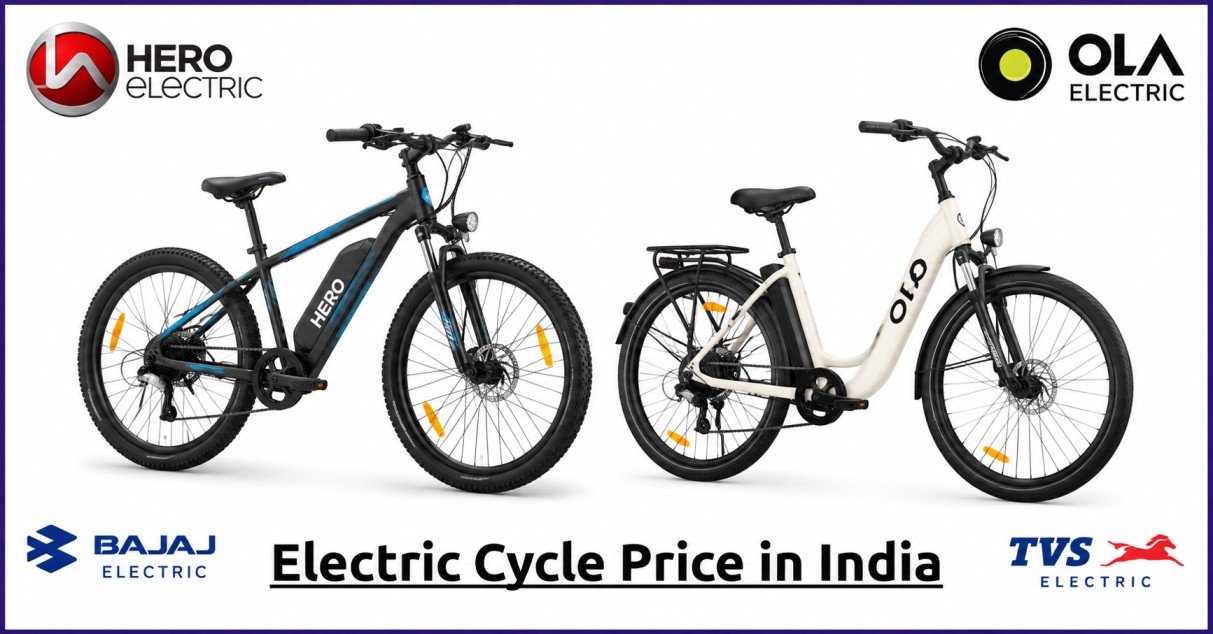
Electric cycles, also called e-cycles or electric bicycles, are becoming increasingly popular in India. They combine the basic design of a bicycle with an electric motor and rechargeable battery, making everyday travel easier and more economical. Electric cycles can be useful for students, office workers, delivery riders, fitness enthusiasts and people looking for affordable short-distance transportation.
In 2026, electric cycle prices in India generally start at around ₹20,000–₹25,000 for basic models, while better-equipped models can cost ₹50,000–₹80,000 or more. Current listings show a wide market with models available across different budgets and riding requirements.
What Is an Electric Cycle?
An electric cycle is a bicycle equipped with an electric motor, battery, controller and charging system. Depending on the model, the motor can assist the rider while pedaling or provide electric power through a throttle.
Most electric cycles designed for everyday Indian city use have motors around 250W and assisted speeds around 25 km/h. Some models offer removable batteries, multiple riding modes, LED lights, digital displays and disc brakes.
Unlike an ordinary bicycle, an electric cycle can reduce the physical effort required to travel longer distances, particularly on roads with slopes or during daily commuting.
Electric Cycle Price in India
The price of an electric cycle depends on the motor, battery capacity, frame, range, braking system and additional features.
A broad 2026 price range is:
| Category | Approximate Price |
|---|---|
| Entry-level electric cycle | ₹20,000–₹30,000 |
| Budget commuter | ₹30,000–₹40,000 |
| Mid-range e-cycle | ₹40,000–₹60,000 |
| Premium electric cycle | ₹60,000–₹80,000+ |
| High-end/folding models | ₹80,000–₹1 lakh+ |
These are indicative prices and can change according to the seller, city, offers and variant. Current Indian listings show electric cycles starting below ₹25,000 and extending considerably higher.
Popular Electric Cycle Examples and Prices
Several models currently available in India illustrate the different price segments.
EMotorad X1: around ₹25,999–₹27,999 depending on listing, with a claimed range around 35 km.
Hero Lectro Y3: approximately ₹26,000–₹29,000, with a claimed range of around 40 km.
Motovolt Kivo Easy: around ₹31,999, with a claimed range that can reach 105 km under specified conditions.
EMotorad T-Rex Air: around ₹37,000, with claimed range figures varying by source and riding conditions.
EMotorad Doodle Pro: around ₹55,999, with a claimed range of up to 60 km.
EMotorad Ranger: around ₹58,999, with a claimed range of up to 75 km.
EMotorad Viper: around ₹66,999, with a claimed range of up to 85 km.
Prices and specifications can change, so buyers should check the manufacturer’s current listing before purchasing.
Battery and Range
The battery is one of the most important components of an electric cycle. Battery capacity is usually expressed in voltage and amp-hours, while watt-hours are useful for comparing energy capacity.
A larger battery can generally provide greater range, although actual distance depends on rider weight, road conditions, speed, tyre pressure, temperature and use of electric assistance.
For example, some current electric cycles claim ranges of 30–40 km, while higher-capacity models advertise 60–100 km or more. These figures should be treated as claimed ranges rather than guaranteed real-world distances.
Charging Time
Charging time varies by battery size and charger. Many electric cycles take approximately 3–6 hours for a full charge, although some models may take longer.
A removable battery can be particularly convenient for people who live in apartments or do not have a charging point near their parking area.
Before buying, check:
- Battery charging time
- Battery warranty
- Whether the battery is removable
- Availability of replacement batteries
- Charger warranty
- Expected battery life
Running Cost of an Electric Cycle
One of the biggest advantages of an electric cycle is its relatively low running cost.
An electric cycle does not require petrol or diesel. Electricity is used to recharge the battery, and the amount of electricity required for a single charge is generally small compared with the energy cost of operating a petrol vehicle.
Maintenance can also be relatively simple because an electric cycle has fewer mechanical components than a conventional petrol-powered two-wheeler.
However, owners still need to maintain tyres, brakes, chains, gears, bearings and electrical components.
Electric Cycle for Students
Electric cycles can be useful for students travelling to college, coaching centres, libraries or nearby locations.
A lightweight model with a moderate battery range can be sufficient for short daily journeys. Students should consider the cycle’s weight, battery-removal facility, charging time and security features before buying.
For short-distance travel, spending more on a very large battery may not always be necessary.
Electric Cycle for Office Commuters
For office workers, an electric cycle can provide an alternative to cars, motorcycles and public transportation for relatively short journeys.
A commuter should pay particular attention to:
- Battery range
- Comfortable riding position
- Braking performance
- Tyre quality
- Charging time
- Service availability
- Battery warranty
A model with a claimed 50–75 km range may provide useful flexibility for daily commuting, although actual range can be lower depending on riding conditions.
Important Features to Check Before Buying
Before purchasing an electric cycle, don’t look only at the price. Compare the complete package.
1. Motor
A 250W motor is common among many Indian e-cycles. Check how the motor assistance works and whether the cycle is suitable for your terrain.
2. Battery
Look at battery capacity, chemistry, warranty and replacement cost.
3. Brakes
Disc brakes can provide stronger braking performance than basic systems, but the overall quality and adjustment of the braking system are also important.
4. Range
Compare claimed range carefully. Two manufacturers may use different testing conditions.
5. Warranty
Battery replacement can be expensive, so battery warranty is particularly important.
6. Service Network
A cheaper cycle may become inconvenient if replacement parts and servicing are difficult to obtain.
Advantages of Electric Cycles
Electric cycles offer several potential benefits:
- No petrol requirement
- Low energy consumption
- Useful for short-distance travel
- Pedal assistance reduces physical effort
- Generally easy to park
- Can be used for exercise
- Lower operating complexity than petrol two-wheelers
- Environmentally cleaner at the point of use
Disadvantages of Electric Cycles
There are also some limitations.
The initial purchase price is higher than that of many ordinary bicycles. Battery performance decreases over time, and replacing a battery can add to ownership costs. Electric cycles can also be heavier than conventional bicycles.
Range may decrease when riding at higher speeds, carrying additional weight, travelling uphill or using maximum electric assistance.
Is an Electric Cycle Worth Buying?
For people who regularly travel short or medium distances and have convenient access to charging, an electric cycle can be a practical transportation option. Budget models around ₹25,000–₹35,000 can provide an affordable entry point, while models around ₹40,000–₹70,000 can offer larger batteries, improved equipment and longer claimed ranges.
The right choice depends on how far you travel, your budget, road conditions and the features you actually need.